Research Categories
Research Categories

Melanotan II

ALL ARTICLES AND PRODUCT INFORMATION PROVIDED ON THIS WEBSITE ARE FOR INFORMATIONAL AND EDUCATIONAL PURPOSES ONLY. The products offered on this website are furnished for in-vitro studies only. In-vitro studies (Latin: in glass) are performed outside of the body. These products are not medicines or drugs and have not been approved by the FDA to prevent, treat or cure any medical condition, ailment or disease. Bodily introduction of any kind into humans or animals is strictly forbidden by law.

Peptides and Tanning Research

How Does UV Light Cause Tanning?

UV light causes tanning, which is to say and increase of the skin pigment melanin, by stimulating a cellular process mediated by the tumor-suppressor gene p53[1]. The whole point of this process is to protect skin cells against UV light, which can damage DNA and lead to problems like cancer, cell death, and the breakdown of extracellular matrix proteins (e.g., collagen) in the skin. This latter effect is what leads to observable skin aging in the form of wrinkles, lines, lost elasticity, and more.The pathway is activated when UV light damages DNA in the upper layers of the skin. The damage done to the DNA results in stabilization and activation of the p53 tumor suppressor protein. This, in turn, promotes activation of proopiomelanocortin (POMC). POMC is cleaved to product alpha-melanocyte stimulating hormone (α-MSH), which then binds to the melanocortin 1 receptor (MC1R). This causes melanocytes to both produce more melanin as well as divide and increase in number. Together, these effects cause an increase in melanin pigment leading to darkening of the skin. The melanin then absorbs the harmful UV light preventing further DNA damage[2].Note that tanning via UV light does not occur until after DNA damage has occurred. This means that the potential for cancer development is already present before tanning occurs because DNA damage has already occurred. Therefore doctors have warned against UV-based tanning for years. The only solution, until recently, has been to avoid UV light entirely by either staying out of the sun or by wearing sunscreen. Unfortunately, recent research shows that sunscreen has problems of its own such as damaging coral reefs and potentially causing hormone dysregulation[3]. The current research is focused on promoting melanin production without exposure to UV light, thus gaining the benefits of melanin protection without first inducing DNA damage.

The New Solution to Sunless Tanning

If scientists could stimulate tanning without the DNA damage that jumpstarts the natural process, then we could experience the benefits of tanning without any of the risks. Research into the tanning pathway has been of interest for several decades now, in part because of the discovery of melanotan and the melanocortin receptor system. Interestingly, melanotan was developed as a sunless tanning agent and then became of interest for an entirely different purpose. It’s ability to protect the skin against UV damage was almost completely forgotten as its ability to stimulate sexual arousal became the focus of melanotan research. Much later, research shifted again and melanotan became a front-runner in sunless tanning research. This peptide has since inspired the exploration and development of other peptides for sunless tanning research. Some of those peptides are discussed below along with other compounds associated with sunless tanning.

What is Melanotan 2 and How Does it Work?

Background Information

The melanocortin system consists of five seven-transmembrane spanning G-protein coupled (GPCRs) receptors (MC1R-MC5R), the endogenous agonists a-, B- and melanocyte stimulating hormone (MSH), adrenocorticotropic hormone (ACTH), and the endogenous antagonists Agouti and Agouti-related protein (AGRP).

The melanocortins are a group of small protein hormones derived by post-translational cleavage of the proopiomelanocortin (POMC) gene product. The known melanocortin hormones include alpha-melanocyte stimulating hormone (MSH), beta-MSH, gamma-MSH and adrenocorticotropic hormone (ACTH). Five melanocortin receptors (MC1R through MC5R) have been identified and most of these show tissue-specific expression patterns, as well as different binding affinities for each of the melanocortin hormones.

The central melanocortin system consists of alpha-MSH, agouti-related protein (AGRP), MC3R and MC4R. AGRP and alpha-MSH are believed to be the natural antagonist and agonist respectively of MC3R and MC4R. This central melanocortin system is thought to play a fundamental role in the control of feeding and body weight.

Knock-out mice models and genetic studies have pointed to the importance of the melanocortins in complex human pathways such as pigmentation, lipolysis, food intake, thermogenesis, sexual behavior, memory and inflammatory response.

Recently the melanocortins and their receptors have been the target for drug-based treatment of human physiological processes. MC3R and MC4R are likely targets for controlling body weight; MCIR may be used in the treatment of inflammation and MC2R for the treatment of glucocorticoid deficiency. A role for MC5R still remains unclear, but the evidence suggests an exocrine gland function.

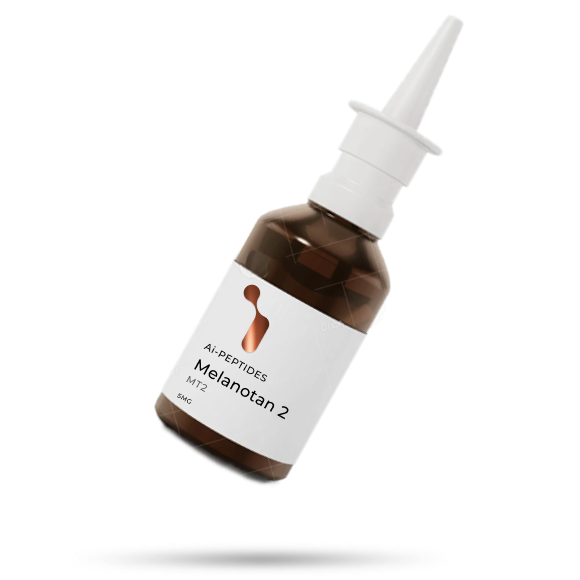

Melanotan II is a synthetic cyclic lactam analog of naturally occurring α-MSH (Melanocyte-stimulating hormone), a truncated version of melanotan I (afamelanotide) with a longer half-life. Melanotan I [Nle4,D-Phe7] α-MSH is a potent non-selective analog of α-MSH with activity at the MC1R, MC3R, MC4R, and MC5R receptors and good in vivo stability and biodistribution, but poor blood–brain barrier permeability. Melanotan II (MTII), Ac-Nle-c[Asp5, DPhe7,Lys10] α -MSH-NH2, is of similar potency and range of effects as MTI but enhanced in vivo stability (T1/2: 1–2 h) and blood–brain barrier permeability because of its cyclic structure.

Melanotan 1 vs Melanotan 2

Melanotan 1 (MT1) and its counterpart melanotan 2 (MT2) are synthetic derivatives of alpha-melanocyte stimulating hormone (a-MSH). Both peptides bind to melanocortin receptors to produce a variety of interesting effects. Of note, both MT1 and MT2 have an impact on melanin expression and thus skin pigmentation. Both also affect sexual arousal, feeding behavior, blood pressure, central nervous system function, and willpower. Given that they are so similar in terms of function, it should come as no surprise that searches for melanotan 1 vs 2 are exceptionally common. Below is a look at how these peptides stack up against one another because even though they are similar in many ways there are also a host of differences in melanotan 1 vs 2.

There are clearly similarities in these two molecules if they are looked at from a higher level. Both affect the skin, central nervous system, and certain aspects of metabolism. Closer inspection reveals that there are nuances within these categories that distinguish melanotan 1 vs 2. These nuances are likely due to specific patterns of receptor binding and will hopefully help researchers to better understand how subtle differences in binding affinities for multiple receptors can fine-tune an entire system. In other words, melanotan 1 vs 2 differences have helped to expand upon the simple on/off dichotomy of early biological thinking. Individual receptors may simply be turned on or off, but entire systems can be gently tuned by turning on or off different numbers of receptors and different types of receptors to produce a spectrum of emergent effects.

Where to Buy Melanotan 2 Online

Melanotan 2 and Melanocortin Signaling

Melanocortins are a collection of potent neuropeptides all derived from proopiomelanocortin (POMC). Though originally thought to only be active in the central nervous system, there is now abundant evidence to show peripheral tissue effects as well. Unfortunately, not much was known about these peripheral effects until the early 1990s when the first melanocortin receptor was identified[1].Melanotan played an important role in discerning the existence of the first melanocortin receptor. Since then, research has revealed five such receptors with a host of properties. Abbreviated MC1R through MC5R, these receptors have the following properties. Research interest in the mt2 peptide is alive and well and goes far beyond the original mt2 tanning research that launched interest in this peptide. For researchers looking to buy melanotan 2 online, the following is a review of the features of this peptide and the research that has been conducted thus far as well as a guide to making an informed purchase of melanotan 2 from the best melanotan 2 source.1. MC1R – Primarily involved in pigmentation (e.g., red hair), MC1R also plays a role in pain perception, development, and infection response.2. MC2R – Exclusive ACTH receptor. In terms of natural melanocortin peptides, MC2R binds ONLY to ACTH. Alternatively called the ACTH receptor, the receptor is associated with lipolysis, anti-inflammatory effects, and several autoimmune disorders.3. MC3R – Appears to play a role in energy homeostasis and is associated with obesity.4. MC4R – Also associated with obesity and energy homeostasis. MC4R and MC2R both require accessory proteins for proper functioning. MC4R plays roles in insulin resistance, sexual arousal, and neurogenesis. There are also links between MC4R and the oxytocin-induced pair bonding seen in prairie voles.5. MC5R – This receptor is associated with sebum production, fatty acid oxidation, lipolysis, and erythrocyte (red blood cell) differentiation. It has been implicated in inflammatory responses, thermal homeostasis, and pheromone production. Interestingly, MC5R expression in the brain is tied to physical activity.

Melanotan II Facts and Myths

Melanotan II is a synthetic cyclic lactam analog of naturally occurring α-MSH (melanocyte-stimulating hormone) developed by the University of Arizona and is known to have skin darkening effects as a result of increased production of skin darkening pigments. In clinical trials, Melanotan II has also been found to have aphrodisiac effects.

Welcome back!

or
Menu
Explore

Search Peptides

Welcome back!

or
0