Research Categories
Research Categories

Hair Follicle Growth

ALL ARTICLES AND PRODUCT INFORMATION PROVIDED ON THIS WEBSITE ARE FOR INFORMATIONAL AND EDUCATIONAL PURPOSES ONLY. The products offered on this website are furnished for in-vitro studies only. In-vitro studies (Latin: in glass) are performed outside of the body. These products are not medicines or drugs and have not been approved by the FDA to prevent, treat or cure any medical condition, ailment or disease. Bodily introduction of any kind into humans or animals is strictly forbidden by law.

How does Thymosin Beta 4 (TB-500) enhance hair follicle growth?

Thymosin Beta 4 Increases Hair Growth by Activating Hair Follicle Stem Cells.

“Thymosin β4, a ubiquitous 4.9‐kDa polypeptide originally isolated from bovine thymus, is a potent mediator of cell migration and differentiation. It was identified as a gene up‐ regulated four‐ to sixfold during early endothelial cell tube formation and found to promote angiogenesis. It is present in wound fluid, and when added topically or given systemically, it promotes angiogenesis and wound healing. Thymosin β4 elicits cell migration through a specific interaction with actin. In angiogenesis and in wound healing, thymosin β4 acts by accelerating the migration of endothelial cells and keratinocytes and increasing the production of extracellular matrix‐degrading enzymes.”
“Thymosin β4 promotes hair growth in normal rats and mice. A specific subset of follicular keratinocytes in the mouse skin, which originates at the bulge region, expresses thymosin β4. The temporal and spatial distribution of these keratinocytes parallel the pattern reported for the stem cells and their daughter TA cells at the different stages of the hair cycle (910). We isolated clonogenic keratinocytes from the bulge compartment of the rat vibrissa follicle, further characterized them as an immediate progeny of the stem cells, and found that these cells express high levels of thymosin β4 when cultured in vitro. We show that thymosin β4 promotes hair clonogenic keratinocyte cell migration, as well as secretion of the extracellular matrix‐degrading enzyme matrix metalloproteinase 2 (MMP‐2).””Thus, thymosin β4 accelerates hair growth, in part, due to its effect on critical events in the active phase of the hair follicle cycle, including promoting the migration of stem cells and their immediate progeny to the base of the follicle, differentiation, and extracellular matrix remodeling.”
“Taken together, our results suggest that in addition to its known angiogenic and wound healing effects, thymosin β4 is a naturally occurring modulator of hair growth that acts by stimulation of stem cell migration, protease production, and differentiation.”
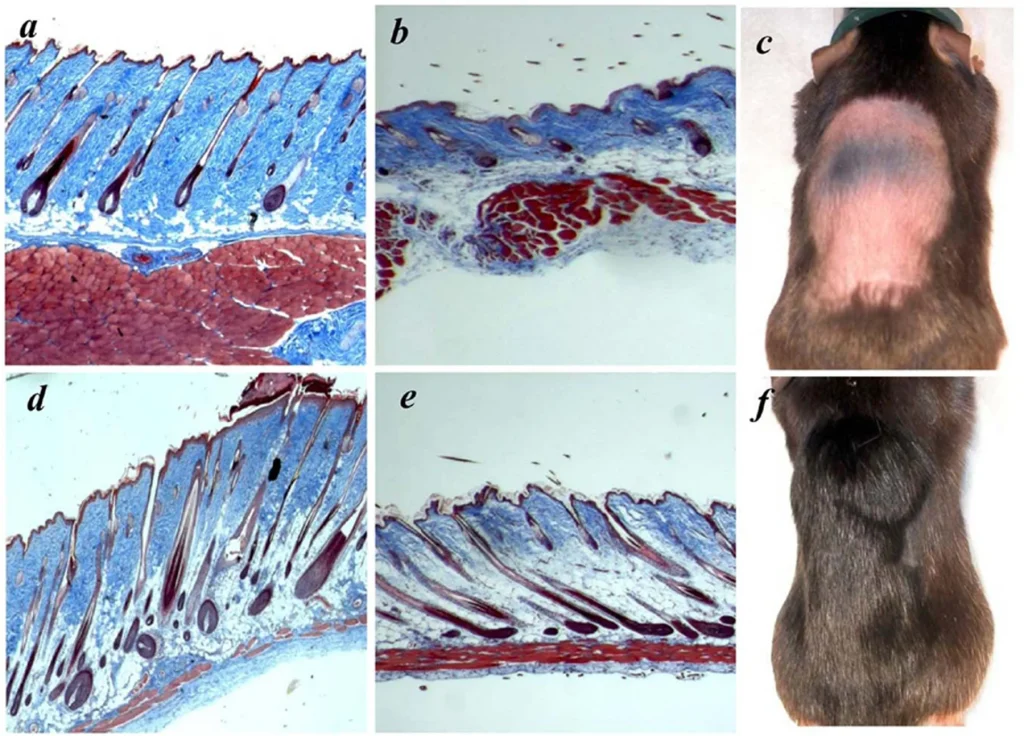
“While studying wound healing in rat skin, we unexpectedly observed visually and at the histological level increased hair growth at the wound margins 7 days after topical treatment with thymosin β4 (unpublished observation). In this study, we have shaved the skin of healthy rats and applied thymosin β4 topically on one side of the shaved area and the control vehicle on the opposing lateral side of the same animal. After 7 days of treatment, we observed an increased number of anagen‐phase hair follicles in the skin areas treated with thymosin β4 (Fig. 1a and d). The number of anagen follicles was approximately twofold greater than in rats treated with vehicle alone. The increased number of hairs in anagen phase was retained with continued tri‐ weekly treatment over 30 days. Within 14 days of treatment cessation, the number of active hair follicles decreased to control levels. We next tested whether thymosin β4 would promote hair growth in 8‐wk‐old C57BL6 wild‐type mice. Animals used in this experiment have all of their hair follicles in the telogen stage as judged by their pink skin color. The mice were shaved and thymosin β4 was applied topically on the shaved area as described in Methods. Control animals were treated with vehicle alone. As shown in Fig. 1c and ƒ, thymosin β4‐treated (but not control) animals displayed quick hair regrowth. Histological examination confirmed the thymosin β4‐induced activation of the hair follicles (Fig. 1b and e).”
TB 500 and Hair Growth

The use of peptides to combat hair loss has gained traction in recent years and several have been studied for their potential to promote hair growth. These peptides work via several mechanisms, including stimulating the growth of hair follicles, altering hormone signaling, improving blood circulation to the scalp, and reducing inflammation. Among the peptides that are of interest to researchers investigating hair loss is TB 500. This peptide has generated some buzz in the scientific and medical communities due to its functional similarity to Thymosin Beta-4 and the fact that it is both easy and more affordable to produce. While initially investigated for its ability to promote hair growth, its applications in wound healing, injury recovery, and tissue regeneration have taken center stage. Recently, however, there has been a rise in research looking at the connection between wound healing and hair growth. This has led to renewed efforts to characterize TB 500 and its function.

Peptides like TB 500 offer promising possibilities for addressing various medical needs, from chronic wounds to musculoskeletal disorders and neurodegenerative diseases. The abilities of TB 500 to accelerate tissue healing, enhance wound closure, promote muscle repair, and support regeneration of neurological tissue in animal models are noteworthy. As a potent anti-inflammatory, TB 500 has a number of potential uses and thus a great deal of research has gone into understanding what it does and how it does it. Here is a look at how TB 500 is of interest to researchers attempting to understand hair growth and loss

What Causes Hair Loss?

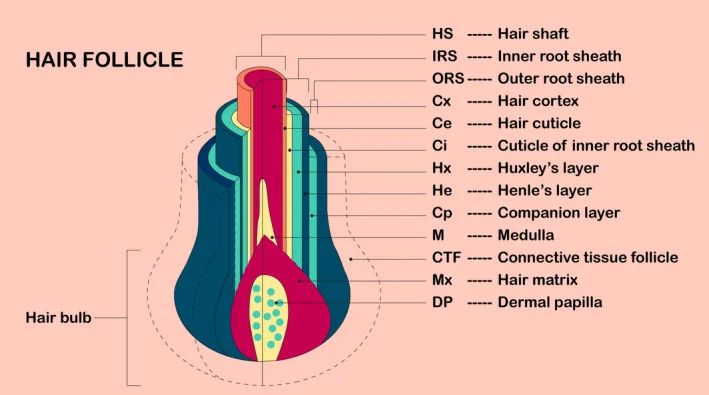
Alopecia (another term for hair loss) can result from a variety of factors depending on the individual. In some cases, multiple factors may contribute to hair loss simultaneously.  The most common cause of hair loss, in both men and women, is due to genetic factors that predispose a person to thinning hair. This is also known as androgenetic alopecia or male-pattern baldness. It tends to run in families and is characterized by a gradual thinning of hair usually on the crown of the head and at the hairline. Researchers know that this type of hair loss is caused by an interaction between the hormone dihydrotestosterone (DHT) and hair follicles that are genetically susceptible to its effects. DHT causes hair follicles to miniaturize over time, leading to shorter, finer, and less pigmented hair. Eventually, affected hair follicles may stop producing hair altogether. Interestingly, the propensity toward male-pattern baldness appears to be more closely related to a family history of baldness on the mother’s side.

Genetics are not the only cause of hair loss, however. Hormonal changes, medications, stress, nutritional deficiencies, and weight loss can all lead to hair loss. In the latter case, crash diets can lead to hair loss by inducing stress and causing nutritional deficiencies[1]. Addressing each of these conditions will often result in cessation of hair loss, but may not lead to hair regrowth. To encourage hair to regrow, additional steps need to be undertaken. To this point, science has only had relatively ineffective topical and oral medications to offer those suffering from hair loss. A better understanding of the hair follicle, however, is helping to change that.

Peptides for Hair Growth Research

Hair Growth Cycle

The growth and shedding of hair take place as part of a three-phase cyclic process. This process applies to hair on the human head, but also body hair, eyelashes, eyebrows, and other hair. The three stages of hair growth are anagen, catagen, and telogen. Healthy hair progresses through these stages in a cyclic pattern, moving from one to the next without getting stuck on any single cycle. In hair loss conditions, hairs prematurely leave the anagen (growth) phase and enter the resting (telogen) phase. This results in a dramatic decrease in or cessation of hair growth followed by overall thinning as the hairs are shed and not replaced.While it isn’t fully understood why hair gets trapped in the telogen phase, there are many clues to potential causes. For starters, the male hormone DHT (a derivative of testosterone) appears to play an important role in hair loss. DHT is thought to diminish blood supply to hair follicles and perhaps increase inflammation that leads to hair loss.Another potential cause of hair loss is changes in nutrient delivery patterns to the scalp. Research suggests that decreased levels of certain B vitamins, for instance, can profoundly impact the health of hair and hair follicles. Changes in nutrient delivery can be caused by changes in blood supply or by inflammation that blocks transport.Finally, hair loss is likely caused by changes at the level of the DNA. Though the mechanisms by which this may occur have yet to be elucidated, scientists speculate that epigenetic changes in DNA expression patterns likely alter the hair growth cycle. For instance, changes in the expression of hormones like DHT or growth hormone are thought to impact collagen and elastin production as well as blood vessel supply. Thus, the underlying cause of much hair loss may be alterations in DNA expression patterns that manifest as changes in hormone levels and blood vessel growth.Of note, knowing the cyclic nature of hair growth has been of limited utility to scientists. This is primarily because there has been little success in delineating what causes hair follicles to move from one stage of the cycle to another. Recent research on the adiponectin peptide, however, has offered science the first glimpse into truly understanding the mechanisms by which hair follicles transition from growth to rest shedding and back again. Here is a look at some of the best peptides for hair growth research that are helping to shed light on how hair grows and how science might be able to overcome hair loss.

Welcome back!

or
Menu
Explore

Search Peptides

Welcome back!

or
0